CHITHUMBA SERVICES - Input Loans
Offering an alternative finance mechanism was Chithumba’s initial focus when it was launched by the Agricultural Commodity Exchange for Africa (ACE) in 2015. It was designed to mitigate the challenges faced by smallholder farmers, particularly with regards to low productivity, lack of access to credit, and limited participation in the formal market. The model proposes a services bundle including three core services:
- Pre-harvest finance for farm inputs;
- Agricultural extension services;
- Market assistance.
The Chithumba model hypothesized that, by offering a holistic bundle of pre-harvest services, based on farmers’ stated demands and needs, farmers would increase the adoption of high-quality inputs, improve their production techniques, and access marketing services through Chithumba. Moreover, increased interaction with producers throughout the entire growing season would increase trust and uptake of services.
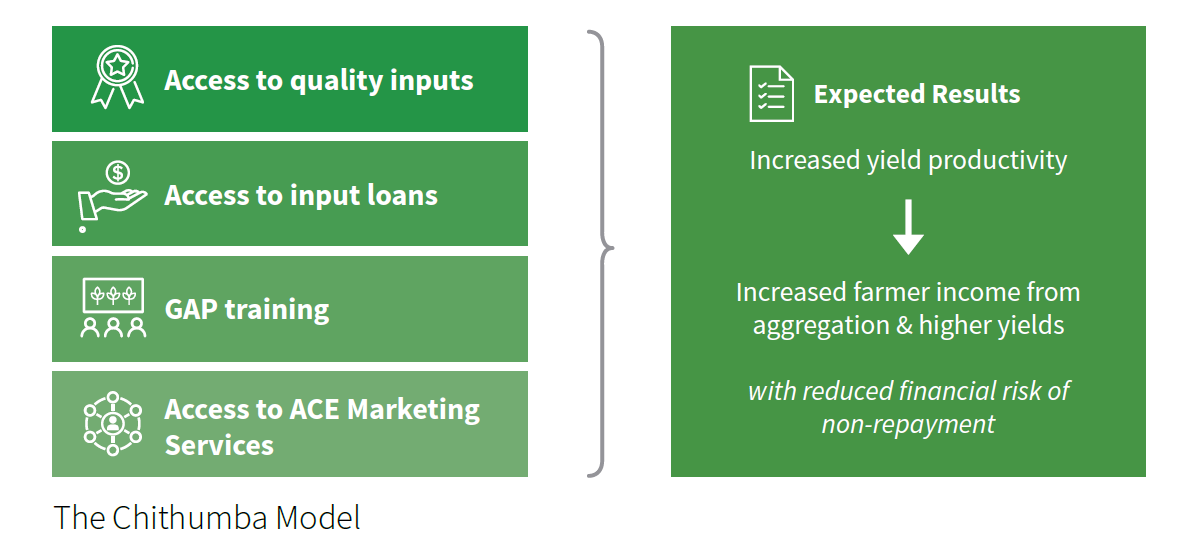
The model was implemented as a project for eight consecutive seasons, targeting soya and groundnut producers across Malawi. In total, inputs worth about USD 830,000 were disbursed through loans, benefiting over 17,600 smallholder farmers spanning 14 districts.
Pre-harvest finance for farm inputs
Selected participants receive agricultural inputs on credit based on screening criteria. For example, farmers must be affiliated with a preselected organised cooperative, have a minimum land size, and express the desire to enroll. While no deposit payment is required, farmers must register with Chithumba prior to input distribution times in order to qualify. The entry package includes soybean and/or groundnut seed and inoculant. Upon harvest, clients repay input loans in kind with bags of grain produced. A set repayment volume is defined at the onset of the season based on the value of the inputs package received and the expected selling price of the repayment volume. The current repayment ratios of 1:5 for soya and 1:4 for groundnut cover the cost of inputs in full (i.e. not subsidized), but do not include other services like Good Agricultural Practices (GAP) training.
Agricultural extension services
To ensure enrolled producers use the inputs provided on credit efficiently, they are all trained on GAP through training days, field visits, and/or demonstration plots. In addition, customized agronomic extension SMS messages are sent using the ACE messaging system. The training modules are delivered by Chithumba staff members, Rural Marketing Advisors (RMAs), and lead farmers selected from participating farmers who receive specific in-depth training. In addition, a meeting with the benefiting farmers to review the model and discuss their performance takes place at the close of each season. Currently, the cost of these services is not embedded into the repayment costs. The justification for providing this level of training was to build social trust with farmers, while addressing low farmer productivity that could impact repayment ability.
To make extension services more accessible, Chithumba is collaborating with the Zaulimi App to integrate GAP content into the app.
Market assistance
Since Chithumba is a non-traditional contract farming model, farmers are required to repay the calculated repayment volume based on the value of the input loan. While farmers have the option to sell their ‘surplus’ volumes through Chithumba after loan repayment, there is no known buyer at the onset of the season. This level of flexibility was deliberate after previous farmer feedback and historic results suggested that the risk of side-selling is significantly reduced when producers can freely choose how to market their commodity. Clients also accessed the ACE Marketing School (AMS), a three-day training offered by ACE Trust that includes Chithumba services, market information, collective marketing and aggregation, trade facilitation, and how to develop and follow a marketing plan. This intensive training is supported by ongoing engagement from Chithumba field staff who continuously provide advice and support to Farmer Organisations, helping turn the newly acquired knowledge and skills into improved access to markets and higher prices for their commodities.
As Chithumba has now transitioned to a for-profit entity, the alternative finance mechanism will gradually include more components. These might be seed production; new crops to reach more farmers; and partnerships with other agricultural actors in Malawi to provide farmers with state-of-the-art training. As such, this will help Chithumba fulfill its vision for developed agricultural production and market across Malawi.